This article is about where I am currently at with my Mandarin, and I wrote it so I can link to it as context in the future. Though I expect it will be of interest mostly to fellow learners, maybe some other people will also appreciate getting a glimpse of what my path to learn this difficult language currently looks like.
Before I delve into where I am at in specific subskills, let me try to give an overall impression of my level. I don’t know the exact amount since I haven’t really tracked, but I have spent a few thousand hours studying Mandarin, the majority of which was reading or listening to content made for natives. Recently, I took a practice HSK 6 exam to get an idea of where I am at, and got a marginally passing score. In the HSK 2.0, which is the one I used, this level is the highest, and the HSK 6 is sometimes compared to a B2/C1-ish level in the CEFR. With that said, I think I am not there yet, specially because I can’t express myself well enough — the HSK is very focused on reading and listening, which is what I practiced the most. If someone asks me what my level is, I just round it down to an indeterminate “intermediate”. My plan is to keep grinding until that label starts to feel like an understatement.
Character recognition and handwriting
In order to read Chinese, one has to become familiar with thousands of characters. Going off my Anki stats, the total number of characters I have ever studied is ~3,400, though the number I can confidently recall is likely in the 2,600-3,000 range. About a year ago, I gave up on Anki, since doing my daily reviews was stressing me out and I wasn’t getting much benefit from learning relatively rare words anyway. Right now though, I’m rebooting that habit, with my main goal being increasing the number of characters I know to 5,000 within 12 months. 5,000 characters should be enough to make dictionary look-ups much less frequent1. I expect that getting that far while also reading a lot will do wonders for my literacy.
I’m also just starting to learn how to handwrite my first characters. Traditionally, handwriting was seen as an essential, albeit awfully time-consuming, step towards literacy. Nowadays though, many students prefer to skip it and learn only the much easier skill of recognizing characters. Getting good at that is already enough to read prose written with clear computer fonts as well as to type on a computer. However, ignoring handwriting altogether like I did makes it hard for me to recognize isolated characters, or those written with different fonts. As I will explain, those are not useless skills, and those limitations carry some bite.
To start with, there are many characters that look similar, and since I can’t reliably distinguish them in isolation, I usually rely heavily on top-down processing to understand a text. For example, I am embarrassed to admit I still sometimes mix up the elementary characters 乌 and 鸟. Usually, when either occurs in a sentence, the context makes clear which of the two it is. One important exception is names, which can contain quite arbitrary combinations of characters, so if 乌 is one of the syllables in a name, I could end up misreading it. Needless to say, most texts include names of people, places, spells, rivers and whatnot, and names can also be seen in storefronts, so I am constantly being bogged down by this limitation either when reading or just looking at commercial streets in China.
As for the other problem, not understanding characters that are not written in neat computer fonts, I think it could be circumvented if I restricted myself to relatively easy ones. For instance, the screenshot below is from See You Again season 4, and the text is written in a computer font that emulates handwriting. I get confused about a few of the characters, but I think with enough practice I could learn to read something like this very comfortably.
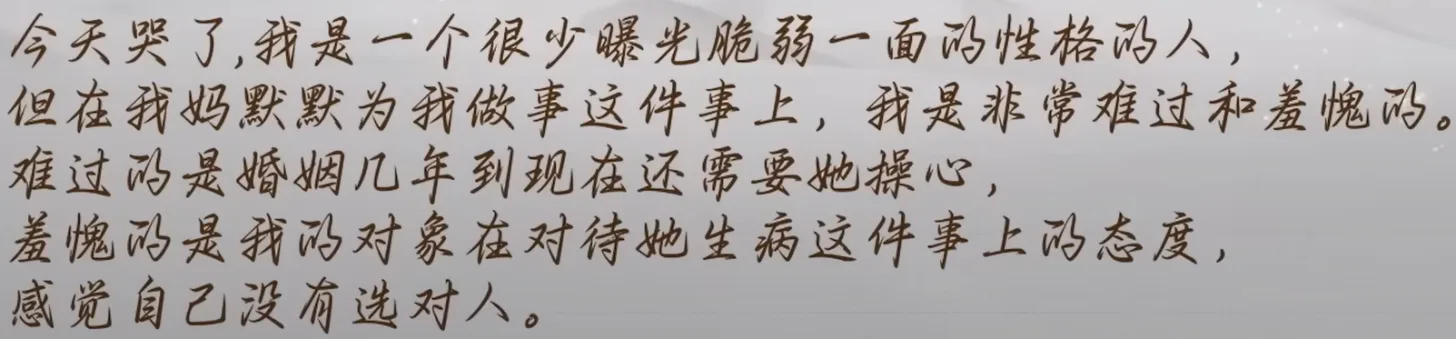
However, when it comes to actual handwriting, natives can merge or omit strokes in ways that are difficult to parse if one is not familiar with how characters are written2. Whenever something the participants wrote was shown on camera in See You Again, I simply wouldn’t get it. Also, the very fact that viewers of the program were expected to be able to read it is proof that this is not an useless ability.

My plan is to learn to handwrite 1,000-1,500 characters. That is way less than the ~5,000 I expect to be able to recognize a year from now, but I think it will be enough for my purposes. The hope is that by internalizing stroke order rules and most radicals, I will develop a closer relationship with the components that make up characters in general. This in turn will lead me to have a much clearer mental picture of even characters that I can only recognize and not write. But frankly, even if that turns out to not be the case, there is no way that learning to write 5,000+ characters is worth my time. I will derive whatever benefits I can from the characters I end up learning to write by hand, and then move on.
Catching-up with listening; starting to speak
Roughly 3 months ago I started practicing speaking, following my first period of solid progress in listening. Before, the fact that my listening sucked discouraged me from wasting time speaking. My reasoning was that listening within a conversation is strictly harder than listening to a podcast, because in addition to the need to understand what is being said, I have to pay attention to social dynamics and come up with what I will say next. That reasoning was always flawed since in one-on-one conversations people can slow down to make it easier for me to understand what they are saying. Still, I wasn’t terribly excited about having simplistic conversations in slow motion, and I didn’t mind waiting a bit.
Anyway, at some point I watched a video in Cantonese, which I shouldn’t understand at all, and noticed that I was able to follow along close to 100% by reading the subtitles in Mandarin. This sucked because the bulk of my listening practice at the time consisted precisely of watching videos while reading subtitles. In the year prior, as I explored different content, I went for harder and harder videos since they tended to be more interesting. Without realizing, I was relying more and more on the subs. When I finally noticed that, some testing made it clear that my listening was fairly bad, so I had to focus more on it.
The first thing I did was to stop reading the subtitles. This simple change then led me to chase easier content, until the point where I was watching channels targeting learners instead of natives, and those were still challenging. The two I enjoy the most are Dashu Mandarin and Chinese Podcast with Shenglan. I found the latter so interesting that I speedran all of Shenglan’s videos on YouTube, then all 300+ premium podcast episodes on her Patreon, within a few months. Way before I was done with all of that though, my listening had already improved substantially, and I thought it was time to finally start practicing speaking for the first time ever.
Having listened to so many episodes of Shenglan’s podcast, I decided to attend her classes for a couple of months. The decision to start with her as a tutor was great, she’s super cool to talk to, extremely patient. Speaking for the first time after studying the language for so long was daunting, and having someone whose content I enjoyed as my conversational partner smoothed out this transition. It also built my confidence, I’m now confident that I can speak, even if it’s guaranteed to have many mistakes and awkward pauses. That’s still enough to have exchanges that both parties find engaging and, with some patience, talk about relatively complex subjects.

Nowadays, I routinely listen to podcasts made for natives, though I wouldn’t be at 100% of comprehension even if I sat down and paid attention, let alone while multitasking. Also, they are all handpicked for being easy. The videos I enjoy watching the most still require lots of pausing and looking up words. This is still the best my listening has ever been, and I’m proud I got this far.
Starting to read traditional; continuing simplified
When it comes to reading in simplified, it’s still arguably my best ability. I’ve read about 10 visual novels and 6 books, not counting children’s books or graded readers. Currently, I’m reading my first ever xianxia3, Cultivation Chat Group, which the Heavenly Path guide recommends as a good entry-point into the genre. Given its length, odds are I won’t go all the way to the end, but so far the story is lots of fun. Earlier this year I read a few short stories by Liu Cixin and enjoyed those as well.
Late last year, I finally started reading traditional. The first thing I read was the Taiwanese visual novel The Rainy Port Keelung. I went in head first without any preparations, just armed with a dictionary. Even the most basic characters that have only minor changes from simplified to traditional required a look-up, and then it took me an absurd amount of look-ups to absorb those characters. It was quite tedious. In the beginning, I was reading a mere 4,000-5,000 characters per hour, in line with where I was when I read my first Chinese visual novel ever, Gaokao.Love.100Days. When I started with The Rainy Port Keelung though, I was used to reading at 2-3x that speed, so starting traditional felt like becoming a newbie again.


It took a long time to start to feel comfortable, and even now it isn’t anything like reading simplified. Fortunately however, after about 70 hours of practice, I am sometimes reading more than 12,000 characters per hour now. I also text with Taiwanese people all the time on HelloTalk with no issues, they write in traditional, I reply in simplified. At least when it comes to easier characters, I rarely misread them or need the dictionary. I’ll still stick to visual novels for a while before tackling easy books, but I’m glad that I didn’t feel the need to go as far back as reading graded readers again to pick up traditional.
The challenges of learning Chinese at this level
People sometimes say that having conversations in Chinese is easy and only the written language is hard, supposedly because of the characters. That could well be the case at an elementary level, after all, a native can always slow down and use simple words to make a conversation possible, but getting over the hurdle of memorizing the first couple thousand characters takes a lot of time, not to speak of other complications like lack of spaces between words. But I’d say that at the intermediate level, listening is trickier than reading. When natives are expressing themselves without taking pains to go slow and simplify, they can speak quite fast, with tons of regional accents and complex vocabulary. By contrast, while reading, I go at my own pace and have convenient access to the dictionary.
My guess is that the situation will reverse again at the advanced level, and reading will become more challenging. That’s because I expect the oral language to be comparatively capped in its complexity, and written texts to go much deeper. Also, there is the issue of skimming ability and reading speed. Having grown up with the Latin alphabet, I’m not convinced I’ll ever be able to get my reading to a level where it feels as effortless as reading in Portuguese or English.
That is due to the script, but some aspects of the language would be tricky even if China somehow made it work with an alphabet. Chengyu comes to mind. Yes, one can get away with just treating them like regular vocabulary words and learn the ones that are actually used frequently through sheer exposure, but I suspect that at the really advanced levels of literacy, some dedicated effort will pay off. Another issue is Classical Chinese4. The way I understand it, that ancient language itself is not really used in modern media, but there are some classically-influenced usages that may become more transparent by spending some time to pick up the basics. I would also say that more broadly, familiarity with the culture is a big thing. China really has a long and fascinating history, and even if it that somehow wasn’t relevant, it is so huge that there would still unavoidably be a lot to learn about just to get up-to-speed with contemporary culture. Chinese internet memes deserve their own dedicated bookshelf.
Why I got on this path and how things will unfold
Overall, my Chinese is moving along at a reasonable pace. Most days, I spend 2 hours on it, and I’ve been doing so for a little under 2 years. Before then I had already read a few children’s books and some 50 or so graded readers, and had about 3,000 words under my belt on Anki, so I absolutely did not start from scratch. With that said, until that point, I never really prioritized Chinese and progressed only very slowly. I decided to crank up my effort because when living in the countryside close to the end of my masters I wanted an escapist hobby that I could do at home. Reading Chinese visual novels and watching donghua perfectly fit the bill. I was stressed and bored, and consuming tons of Chinese entertainment media was a productive way to get through that.
The most unexpected thing I found along the way is how intriguing modern Chinese society turned out to be. The more I learn, the more fascinated I get about this culture. Shenglan’s podcast has been a treasure trove in this regard, introducing me to tons of memes and little corners of life one wouldn’t even think about otherwise without stepping foot on China.
I’ve been doing this as a hobby and mostly disconnected from speakers, and I’m curious how things will unfold as I integrate more and more into the Chinese-speaking world. Acquiring English changed my life, and I expect Mandarin to have a comparable effect, especially as I reach the upper-intermediate level and beyond.
Footnotes
-
E.g., Imron argues by referencing a corpus that 4,400 is a healthy number to read fiction, and several of the books recommended by the Heavenly Path surpass 5,000 unique characters. Another bit of supporting evidence for this number comes from reports by advanced students. Reddit user onthelambda says
[…] it’s definitely the case that there is a point where you can more or less just…stop having to try so hard. I think that point is definitely far beyond 3k characters, though past that point the effort curve does start to ease up quite a bit. At 5k it eases up very, very much. ↩ -
Hacking Chinese has a great article about acquiring the skill understanding handwriting. ↩
-
Xianxia is a genre of Chinese fiction that uses difficult language and is thus considered advanced for learners (Wikipedia). ↩
-
Classical Chinese is another topic which I learned about from an excellent Hacking Chinese article. ↩